Constructing
‘the people’ in India today
SATISH DESHPANDE
AS the founding
fiction of every republic, ‘the people’ is a phantom phrase that is at the
heart of practical politics. In English and European languages, the term has
three basic senses: ‘the people as sovereign; peoples as nations; and the
people as opposed to the ruling elite’.1 While the political etymology of equivalent
terms in Indian languages is more complicated, my focus here is on the uses of
the term in the practice of politics.
In this specific
context, ‘the people’ is simultaneously two different things. First, it is a
taken-for-granted cliché whose meaning is pre-given, invoking an entity that is
presumed to be always-already in existence, and is an essential everyday
referent in political speech. In a second, more complex sense, ‘the people’ is
a sort of asymptote, a permanent destination at which there is no final
arrival, and thus an ongoing project always ‘under construction’ that is common
to all politics with hegemonic ambitions.
Ever since the
global prominence of what is referred to as ‘authoritarian populism’, the
question of ‘the people’ as a political project has received considerable
scholarly attention. Among the most influential perspectives on this subject is
the one based on Gramscian political theory,
developed further using poststructuralist concepts by Ernesto Laclau.2 Building on the Gramscian
concept of hegemony (a durable form of domination-with-consent), Laclau suggests that populism is a form of political reason
that depends on building (and nurturing) chains of equivalence and difference.
Here, ‘equivalence’ refers to the ideological manoeuvring of a cluster of
social groups into a common (shared) relationship with a particular
reference-group.
A familiar example is the creation of a common enemy, where a shared
hatred or fear serves to overcome (or temporarily mask) mutual differences.
However, social identities are themselves the products of the play of
difference – they depend on contrasts with other groups rather than on any intrinsic traits. This
means that the (constructed) equivalences among groups are always vulnerable to
the search for distinguishing marks, or the attractions of an alternative
ideology and its chain of (different) equivalences.
Thus, populist
political movements aiming for hegemony must constantly work to produce and
sustain relations of attraction and repulsion in a way that facilitates their
own rise to dominance on a wave of popular support. In modern democracies, this
means doing everything necessary
to win elections. And in a large democracy like India, it also means juggling –
and aggregating – different strategies that are effective for different
constituencies (i.e., social groups and communities) and at different electoral
levels (for example, the national and regional levels).
Seen from another
angle, the work of politics is about building or breaking connections among
social groups; the aim is to bring as many groups as possible into one’s own
coalition by building connections, and simultaneously trying to break the
connections that link rival coalitions. In sum, politics is about constructing
‘the people’ in a way that will enable the capture of power in a legitimate
manner, that is, with the active consent of ‘the people’.
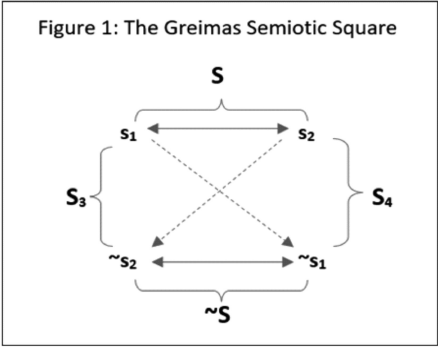
In this essay, I
want to focus on a particular conceptual device that can help map the
ideological terrain on which ‘the people’ is constructed. This device is called
the semiotic square and it has been developed by the French semiotician
A.J. Greimas.3 The semiotic square is constructed by first
positing a relationship of contrariety between two concepts or, as in this
case, social identities, shown as (lower case) s1 and s2. Contrariety implies
a strong opposition that nevertheless falls short of being directly
contradictory.
In logical terms,
contraries are not mutually exclusive – they can both be true, or both be false, but because of their mutual opposition, any
attempt to encompass or transcend them must be a relation of ‘creative
tension’. The initial terms s1 and s2 give rise to their respective contradictory
terms, Not-s1 and
Not-s2, shown as ~s1 and ~s2 (~ = Not). Contradictories are mutually
exclusive – nothing can belong to both s1 and ~s1 (or s2 and ~s2)
at the same time. The initial relationship of contrariety between s1 and s2 also implies a
transcendent term, (shown here as upper-case S) which tries to straddle the two
sides and is sometimes referred to as the utopian term. In similar fashion,
there is a transcendent term attempting to straddle ~s1 and ~s2,
represented here as ~S. The square offers the possibility of two more positions
that would keep in creative tension the left and right corner terms, s1 and ~s2 (shown as S3) and s2 and ~s1 (S4).
The semiotic square
has an important place in the technical literature of semiotics and
linguistics, but it is being invoked here only as a heuristic device for
mapping an ideological terrain. As the literary critic Frederic Jameson, one of
the earliest scholars to popularize its use outside of semiology suggests, it
cannot be a substitute for insight or intuition, but is best used as a ‘visual
device to map out and to articulate a set of relationships that it is much more
confusing, and much less economical, to convey in expository prose’.4 The following
discussion uses a semiotic square adapted to the current ideological terrain of
politics, and the contesting projects for constructing ‘the people’ currently
under way.5
Let me quickly
describe the basic features of the semiotic square shown in Figure 2 below
before going on to a more detailed discussion. The square begins with the
relation of contrariety between the social identities ‘UpperCaste’6 and ‘Hindu’
(equivalent to s1 and
s2 in Figure 1).
These two terms generate their contradictories, ‘Not-UpperCaste’
and ‘Not-Hindu’ in the diagonally opposite lower corners of the square. The
transcendent term at the top of the square is formed by keeping the identities UpperCaste and Hindu in creative tension, and this has been
the composite identity of the ruling elite in post-Independence India. In the
same way, the underclass is composed of the minority religious communities
(Not-Hindu) and the Adivasis and lower castes (Not-UpperCaste).
In addition to the
normal semiotic square, Figure 2 also shows a vertical axis of domination, and
a horizontal axis of legitimation. Political movements and projects must
negotiate the trade-off between the two axes, moving roughly from the bottom
left corner (where the axes meet) in a diagonally outward direction, gathering
as much height (in terms of domination) and as much width (in terms of
legitimation) as possible. The arc on the left marks the rough arc of the
people-construction project of the Indian National Congress since Independence,
while the arc on the right marks the arc of the Bhartiya
Janata Party and the Sangh Parivar.
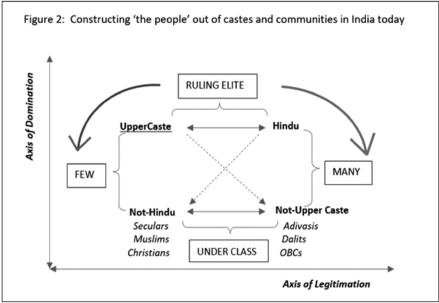
The square shows
that while both formations are led by an UpperCaste-Hindu elite, their legitimation strategy has
been different. The Congress has been traditionally hesitant to foreground
Hindu identities in public and has had a long stint of working with minorities
(particularly Muslims) and Dalits and Adivasis, though its experience with the OBCs has been more
mixed. The BJP-Sangh-Parivar
formation is currently countering the long-standing arc of Congress politics
with its own Hindutva-centric strategy that
foregrounds Hindu identity and singles out Muslims (and what it describes as
elitist seculars) as the enemy of the people.
Electoral
legitimation necessarily involves numbers, and so the people-building exercise
aimed at hegemony must try to garner the majorities necessary to capture and
retain power. Both the Congress and the Hindutva arcs
must therefore aim to capture a significant portion of the largest numbers,
which are in the lower castes, but the route they take, and the equivalences
and differences they attempt to construct are different. The BJP has (since
2014) committed itself to the rightward arc, where it has decided to ‘expel’
the so-called non-indigenous minorities (especially Muslims, and to a lesser
extent, Christians) as well as the secular elite and designate them as enemies
of the people.
All other groups are being asked – or invited,
persuaded, taught – to adopt the same relationship of enmity and hatred towards
them. The hope is that this shared antipathy will paper-over the differences
and inequalities that separate the Adivasis, Dalits and Backward Castes from each other,
and also, of course, from the upper castes. Thus, the BJP arc can (in
principle) muster sufficient electoral legitimation without going beyond the
Not-UpperCaste groups toward the Not-Hindu groups.
But to do this, it must stress the top-right-hand corner of Hindu identity. By
contrast, the Congress strategy – if it is to downplay the Hindu side of UpperCaste identity – is required to push beyond the
Not-Hindu groups to woo the Not-UpperCaste groups. To
prevent this from happening, the Hindutva forces are
‘heating up’ the Not-Hindu corner to such an extent that it becomes a liability
for its rivals, so that the only route to an electoral majority is the Hindu
route, so to speak.
This is the initial
pass through the semiotic square and the terrain it maps. We must now get down
to a more detailed discussion of the strengths and limitations of the square as
well as its silences.
The first thing to point out is that the semiotic
square maps the space of possibilities in a given context in an intuitively
helpful way. It is a map of modalities that processes all inputs in the same
way – what it reveals depends on what was put into it. In particular, a lot
depends on the inaugural move which specifies the terms involved in the initial
relationship of contrariety. It is because Figure 2 juxtaposes Upper Caste
identity against Hindu identity that we get the subsequent mapping that locates
other communities/identities in the political space. ‘You must blacken many
pages before you get it right’, as Jameson7 says, because it is mostly through trial and
error that the most productive formulation emerges.
Having tried many
alternatives, I would like to make a case for the centrality of the
relationship of contrariety that forms the Upper Caste-Hindu axis. There is the
simultaneous presence here of both oppositional and assimilative tendencies.
The opposition stems from the fact that the Hindu identity (if left
undisturbed) would tend to overshadow the Upper Caste identity and rob it of
the sense of hierarchical distinction that is its non-negotiable core. On the
other hand, non-Hindu modes of being Upper Caste are available only to the most
privileged sections of the elite, who are electorally marginal. The
all-important question here is: Will the Upper Caste Hindu be content to be
just a Hindu – that is, a casteless Hindu?
For most upper caste
Hindus, most of the time, the answer has been a flat no. The qualified yes that
has seemed possible for the top rungs of the elite in recent times is an
illusion because it is only an in-principle refusal of caste, contingent on the
continued enjoyment of its privileges in practice. One could go so far as to
argue that it will require nothing short of a revolution to purge the Hindu
identity of caste hierarchy. The day that this becomes possible on a mass scale,
the square in Figure 2 will be turned counter-clockwise and its right side will
become its top, with the initial contrariety being that of Hindu and Not-UpperCaste. But such a revolution is hard to imagine today
– indeed, a ruling regime without the Hindu upper castes does not seem to be a
part of the foreseeable future.
If the Hindu upper castes are to be an integral part of
all conceivable avatars of dominance, then the semiotic square highlights the
crisis of legitimacy this implies. For the weight of numbers is overwhelmingly
in the two lower corners – more than four-fifths of India’s population is
covered by the groups listed there, with the Hindu upper castes being less than
a fifth of the population. So, the construction of the people inevitably
involves building alliances with the groups defined by the contradictories
Not-Upper Caste and Not-Hindu.
The question of
mutual antipathies or incompatibilities among these groups becomes crucial
here. An obvious example is the tension between the Backward Castes and the Dalits, manifested in violent clashes across most of rural
India. A different instance is provided by
the Adivasis and their continued marginalization, not
to speak of inter-regional tensions within the category.
Though it requires
intricate social engineering and intensive ideological labour, there are
political opportunities here for the building of equivalences. The Hindutva forces have been partly successful in eliciting
lower caste and Adivasi allegiance to the Hindutva agenda. This success has been gained with the
implicit offer of equality (or the dilution of caste hierarchy) in return for
active participation in the larger campaign of Muslim hatred. This is
ideologically and psychologically feasible because, in terms of social status,
the lower castes have nothing to lose and everything to gain from becoming
Hindus on par with (or even indistinguishable from) upper caste Hindus. But the
reverse is not true – for the upper castes, a generic Hindu identity involves a
significant cost in terms of the loss of distinction (in the Bourdieu sense).
It remains an open question whether such equivalences are sustainable in the
medium to long-term, but they are certainly being tried.
It is obvious that many things relevant to the
contemporary political terrain have been left out of the semiotic square shown
in Figure 2. The most striking absence is that of class-based identities, and
economic factors in general. Indeed, this is a remarkable feature of politics
today, providing a
striking contrast with the develop-mentalist idiom that lasted nearly seven
decades. Even as late as the 2014 general election, the Modi
campaign had a significant economic component. But today it is hard to find
examples of economic issues that have generated political activity – the
farmer’s movement against the new farm laws is the only prominent exception.
Major economic disasters such as the demonetization fiasco, the savage impact
of the Covid-19 pandemic, and the alarming employment situation have failed to ignite
popular protests.
It is no surprise
therefore that an attempt to produce a semiotic square beginning with an Upper
Caste-Upper Class axis did not yield useful results. The absence of class in
this story awaits an adequate explanation.
Another important
aspect of contemporary politics that proved difficult to accommodate in the
square is regionalism. As many scholars have emphasized, politics in India
needs to be understood in a disaggregated fashion, separating the national from
the regional or state levels. Perhaps this can be done with a new semiotic
square designed to address these issues. As an aside, it may be noted that the
farmer’s movement can also be interpreted as an instance of regional politics.
Finally, there
remains the question of whether devices like the square can offer insights
about ‘spontaneous’ movements like the anti-CAA-NRC movement of 2019-20. This
too is an open question inviting further experimentation.
In conclusion, let me emphasize that the key insight
offered by the version of the semiotic square in Figure 2 is the centrality of
the caste question to the politics of Hindutva.
Today, it may even be said that caste is its final frontier – for beyond this
last hurdle, hegemony awaits.
This may not seem so
counter-intuitive if one recalls the proposition that equivalences dull the
edge of differences, but differences are the essence of identity. On the one
hand, building and nurturing chains of equivalences is the only stable route to
hegemony in modern democracies. On the other hand, the will to dominance
expressed in the drive for hegemony demands an assertive identity as its
vehicle. However, (as Gramsci taught), a social group with hegemonic ambitions
must be willing to make short term sacrifices in order to achieve long term
gains. But what if it is the most cherished aspect of identity that is required
to be sacrificed?
The Hindu upper castes have always ruled independent
India, albeit in different avatars. Today, in their Hindutva
avatar, they appear to be on the brink of hegemony. But the single point agenda
of demonizing Muslims cannot ensure that this hegemony will be durable – or
legitimate – enough. To make it so, space will have to be ceded in a real and
meaningful way to the lower castes who form the
overwhelming majority of Hindus, going far beyond the tokenism of a nominally
backward caste supremo. If the ruling castes of India wish to retain their hold
on power, they will have to share it with those whom they have always believed
to be their inferiors. They will have to choose between their UpperCasteness and their Hinduness.
References
Margaret Canovan, The People. Polity Press, Cambridge U.K., 2005.
Partha Chatterjee,
I am the People: Reflections on Popular Sovereignty Today. Columbia
University Press, New York, 2020.
James Clifford, The Predicament of Culture: Twentieth-Century
Ethnography, Literature and Art. Harvard University
Press, Cambridge, 1988, Ch.10.
Satish Deshpande,
‘Imagined Economies: Styles of Nation-Building in Twentieth Century India’, Journal
of Arts and Ideas 25-26, 1993, pp. 5-35.
A.J. Greimas,
On Meaning: Selected Writings in Semiotic Theory. University of
Minneapolis Press, Minneapolis, 1987.
Frederic Jameson,
‘Foreword’, in A.J. Greimas, 1987, op. cit., pp.vi-xxii.
Frederic Jameson, The Political Unconscious: Narrative as a Socially
Symbolic Act. Routledge, London, 1983, Ch.
3.
A. Kalaiyarasan
and M. Vijaybaskar, The
Dravidian Model: Interpreting the Political Economy of Tamil Nadu. Cambridge
University Press, New Delhi, 2021.
Ernesto Laclau, On Populist Reason. Verso,
London, 2005.
Footnotes:
* An earlier version of this argument was presented at the SOAS-CSDS workshop on The Indian Republic at 75 on 5-6 April 2022. I am grateful to the participants of the workshop, especially Aditya Nigam, Harish Wankhede, Hilal Ahmed and Vidya Venkat for comments and suggestions which have helped improve it.
1. Canovan
2005:2
2. See in particular Laclau 2005 among other well known works. For recent
attempts to make use of this general line of argument in the Indian context,
see Chatterjee 2020 and Kalaiyarasan
and Vijaybaskar 2021.
3. The
most accessible discussion is perhaps in Greimas
1987, especially Jameson’s Foreword to this volume.
4. Jameson 1987:xiv
5. For other attempts to
use the semiotic square for interpretational purposes outside of semiotics
proper, see Jameson 1983, Clifford 1988, and Deshpande
1993.
6. I am capitalizing this
phrase and making it into one word whenever it refers to a location on the
semiotic square, in order to distinguish it from the ordinary language usage.
7. Jameson 1987:xv.